Abstract
This paper examines how investment freedom affects the use of natural resources, measured as mineral production, across developing countries, using a new mine-level dataset covering over 30 minerals from 2000 to 2018. We link country-level indicators of investment freedom to mine-level output, and estimate the causal effect using an instrumental variables strategy that exploits regional waves of democratization. Our results show that greater investment freedom leads to significantly higher production, consistent with the idea that better institutional conditions reduce capital risk and encourage productive investment. Specifically, we find that a one-unit increase in investment freedom generates a 3.4% increase in mine production, which is more pronounced for underground mines. We find meaningful heterogeneity in this effect. First, the positive effect of investment freedom is attenuated for mines producing critical raw minerals, suggesting that the high strategic value and rents associated with these minerals compensate for institutional risk. Second, we document that the positive impact of investment freedom is stronger at lower mineral price levels, suggesting that policy certainty is especially important when market incentives are weak. Both results point to a unified pattern: when the value of mineral extraction is high, whether through strategic designation or market prices, firms are less sensitive to institutional conditions.
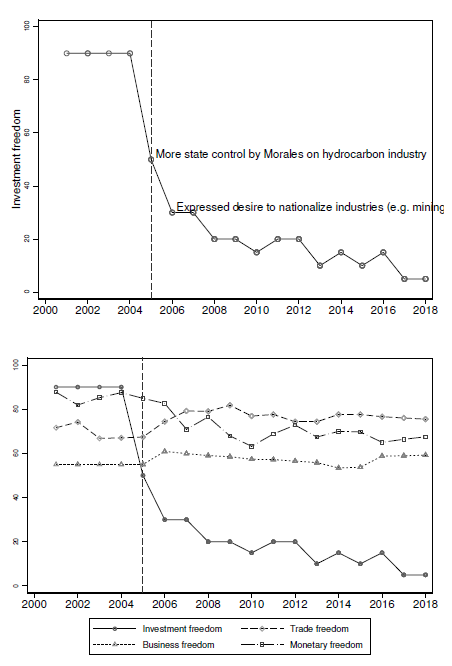
Investment freedom and institutional change in Bolivia, 2000–2018
Authors
Steven Poelhekke (Vrije Universiteit Amsterdam and CEPR) and Gabriel Rodríguez-Puello (Jönköping International Business School)